
Peptides explained
Eloralintide: how it works
Also known as: LY3841136
Page updated · Sources and editorial approach
Eloralintide explained: selective amylin signalling, published phase 2 obesity findings, phase 3 development and the distinction from EloraTZP.
Eloralintide at a glance
What it does biologically
Eloralintide is designed to activate amylin receptors involved in fullness and food intake. It is a different pathway from a GLP-1-only agonist.
What the evidence shows
A published 48-week phase 2 trial studied adults with obesity or overweight. Lilly's September 2026 update describes phase 3 monotherapy trials.
What remains uncertain
Long-term benefit and risk, regulatory decisions and results from later trials remain important. This page is a development explainer, not a product announcement.
The basics
What is Eloralintide?
Eloralintide, also known as LY3841136, is an investigational selective amylin receptor agonist developed by Lilly. Amylin is a hormone involved in the body's response to eating. The drug is being developed for obesity and related cardiometabolic conditions.
The correct published name is eloralintide. It is distinct from retatrutide, tirzepatide and the investigational combination EloraTZP. A similarly spelled product label does not establish that it is the trial medicine.
Biological action
How does Eloralintide work?
Eloralintide is designed to preferentially activate the amylin 1 receptor. The development rationale centres on satiety and reduced food intake. That receptor target is different from the GLP-1, GIP and glucagon targets discussed in incretin-drug research.
Lilly is also investigating eloralintide with tirzepatide as EloraTZP. A combination result concerns both agents and the trial population; it should not be assigned to eloralintide alone or treated as support for self-directed combinations.
Questions being investigated
What do studies examine?
Weight outcomes
The phase 2 monotherapy trial measured percentage body-weight change over 48 weeks in 263 adults without type 2 diabetes.
Later development
Lilly reports phase 3 monotherapy studies. Trial phase labels should be dated and distinguished from a marketing authorisation.
Combination research
EloraTZP has a separate development programme involving the amylin and GIP/GLP-1 pathways.
What individual studies found
Randomised, placebo-controlled trial; 263 adults
48-week phase 2 monotherapy trial
The publication reports greater average weight reductions in the active-treatment groups than placebo.
How to read this: This is evidence for the study intervention and population, not an assurance of individual results or equivalence of a separately supplied item.
Read the original study ↗Strength of evidence
How strong is the evidence?
Evidence is separated by level because a cell experiment, an animal model, a human trial and a regulatory decision answer different questions.
| Evidence type | What it tells us |
|---|---|
| Laboratory | Receptor pharmacology underlies the selective amylin development programme. |
| Animal | Preclinical findings inform development but cannot establish a human benefit on their own. |
| Human | A peer-reviewed phase 2 monotherapy trial is available. Phase 3 development is described in the sponsor's September 2026 update. |
| Regulatory | The linked sources describe eloralintide as investigational; phase 3 is not approval. |
Important context
Risks, limitations and unanswered questions
- Trial findings apply to the studied medicine, eligibility criteria and follow-up.
- Sponsor announcements should be distinguished from peer-reviewed full reports.
- Combination findings cannot be assigned to monotherapy.
- A product label does not establish equivalence to the medicine studied in a clinical trial.
Reading the original evidence
Read amylin research on its own terms
The phase 2 trial enrolled 263 participants and followed treatment for 48 weeks. Eloralintide's amylin-receptor programme is distinct from the incretin mechanisms discussed for tirzepatide and retatrutide. Separate studies do not establish a ranking between these compounds.
Question to take to the source: Is the comparison based on a direct trial, or on studies with different participants, protocols and endpoints?
Check the original source ↗For personal accounts and research questionnaires, read user feedback and patient-reported outcomes.
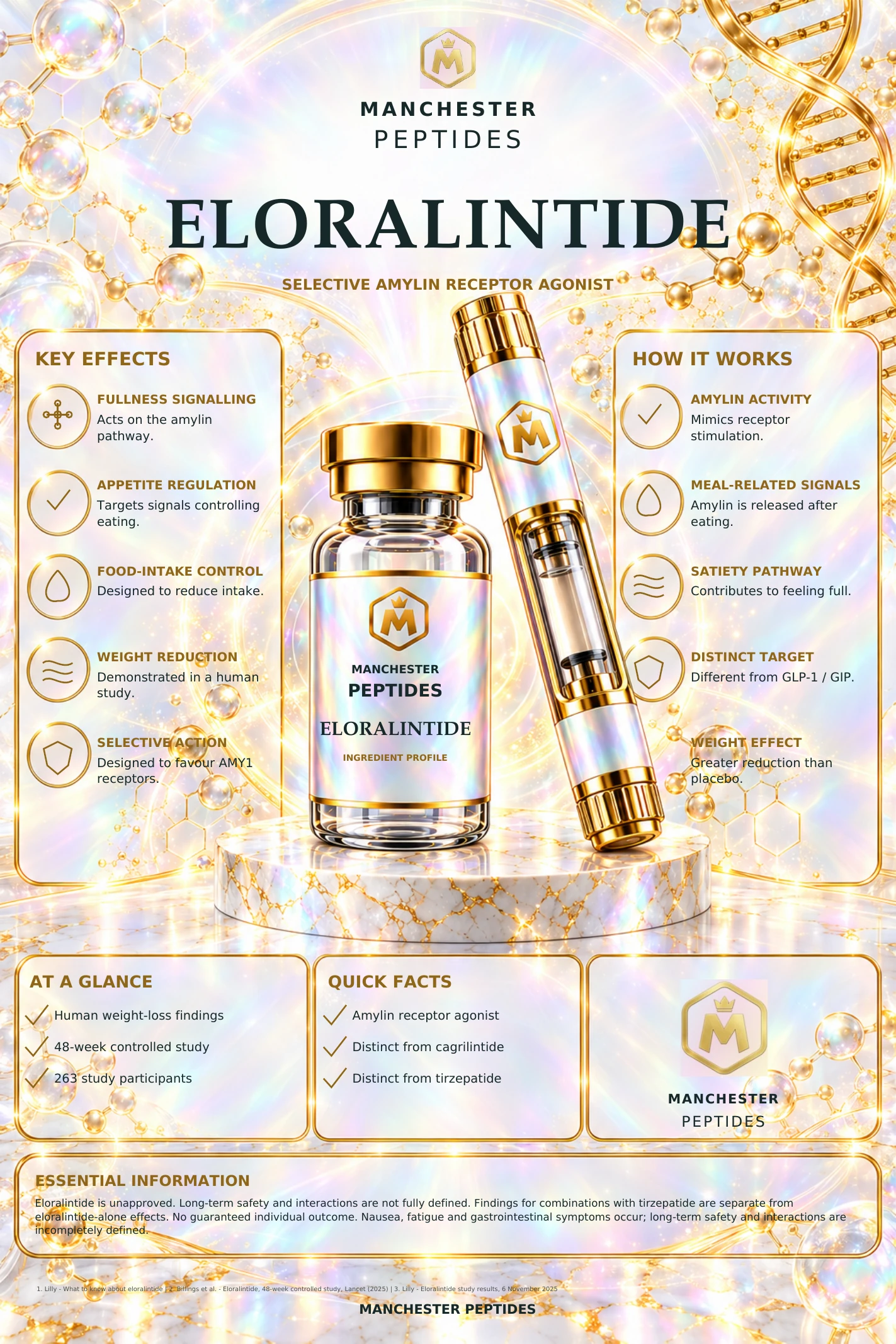
EloralintideView information poster+
Eloralintide information poster
A visual reference for amylin receptor research, appetite signalling and the eloralintide development programme.
- Amylin receptor activity
- Appetite signalling research
- Clinical development
This visual summary is a starting point. The linked research guide provides sources, evidence levels and limitations.
Questions answered
Eloralintide FAQs
Is eloralintide still only in phase 2?
No. Lilly's September 2026 update describes phase 3 monotherapy trials after completed phase 2 work. Combination programmes can be at a different stage.
Is eloralintide the same as EloraTZP?
No. EloraTZP combines eloralintide with tirzepatide.
Does phase 3 mean a medicine is approved?
No. Later-stage trials still test benefit and risk. Approval is a separate regulatory decision.
Check the sources
Sources and further reading
Follow the original study or official information to check the population, methods and full results. Reviews and sponsor updates are labelled below.
- Billings et al.: 48-week phase 2 trial ↗Peer-reviewed randomised trial in The Lancet; 263 participants.
- Lilly: what to know about eloralintide ↗Sponsor update dated September 2026; explains monotherapy and combination development.
- ENLIGHTEN-1 registry ↗Official study record; consult the registry for current status and protocol information.
Detailed weight-loss clinical research
Educational information, prepared with AI assistance and not independently clinically reviewed. It is not personal medical advice or a treatment recommendation. Read the editorial policy or suggest a correction.