
Peptides explained
KLOW: how it works
Also known as: Four-component peptide blend
Page updated · Sources and editorial approach
KLOW explained: GHK-Cu, BPC-157, TB-500 and KPV, the biological questions behind the blend and why component findings do not prove combination benefits.
KLOW at a glance
What it does biologically
KLOW is a name for a mixture, so it has no single established mechanism. Its components are associated with matrix biology, cell movement and inflammatory pathways.
What the evidence shows
The linked experiments study individual components, mainly in cells and animals. They do not test the complete KLOW mixture.
What remains uncertain
Combined effectiveness, interactions, stability and long-term safety cannot be inferred by adding the component claims together.
The basics
What is KLOW?
KLOW commonly refers to GHK-Cu, BPC-157, TB-500 and KPV in one blend. It is a commercial name rather than a standard scientific definition. The name alone does not establish the sequence, ratio or amount of any component.
The four ingredients are chemically distinct. GHK-Cu is a copper-binding tripeptide; BPC-157 is a 15-amino-acid experimental peptide; KPV is the lysine-proline-valine fragment of alpha-MSH; and TB-500 is a label used for thymosin-beta-4-related materials. Exact identity matters before comparing any experiment with a blend.
Biological action
How does KLOW work?
The rationale combines several different biological questions. GHK-Cu experiments examine collagen production and extracellular matrix. BPC-157 studies examine tendon-cell movement and stress survival. Thymosin beta-4 studies examine actin-associated cell migration and wound responses. KPV experiments examine inflammatory signalling in epithelial and immune cells.
Those pathways may overlap, but overlap is not evidence of synergy. A mixture can behave differently because of chemical stability, exposure or interactions. None of the component studies linked below establishes what the complete KLOW blend does in a person.
Questions being investigated
What do studies examine?
Skin and connective tissue
Collagen and matrix findings come from component experiments, not proof that the blend repairs skin or joints.
Cell migration
Tendon-cell and wound models ask how cells move and organise during repair.
Inflammatory pathways
KPV has been studied in intestinal-cell and mouse models. That does not establish treatment of inflammatory disease with KLOW.
Strength of evidence
How strong is the evidence?
Evidence is separated by level because a cell experiment, an animal model, a human trial and a regulatory decision answer different questions.
| Evidence type | What it tells us |
|---|---|
| Laboratory | Separate component experiments are available; no whole-blend mechanism is established by those experiments. |
| Animal | The cited animal findings concern individual ingredients, not the complete mixture. |
| Human | The sources below provide no controlled human trial establishing the effects of the complete KLOW blend. |
| Regulatory | A blend name or component paper does not establish a licensed medicinal indication. |
Important context
Risks, limitations and unanswered questions
- Ingredient ratios must be checked rather than assumed from the blend name.
- A result for full-length thymosin beta-4 cannot automatically be assigned to TB-500.
- Component results do not establish combination benefits or rule out interactions.
- The cited studies do not establish KLOW as a treatment for sleep, anxiety, injury or gastrointestinal disease.
Reading the original evidence
A blend needs its own evidence
The cited studies address individual components in different experimental systems. A four-component blend adds questions about identity, interactions and whether the combined preparation has been studied at all. A list of plausible mechanisms is not a measured result for the mixture.
Question to take to the source: Can the claim be traced to an experiment on the exact blend, rather than four unrelated ingredient summaries?
Check the original source ↗For personal accounts and research questionnaires, read user feedback and patient-reported outcomes.
KLOWView information poster+
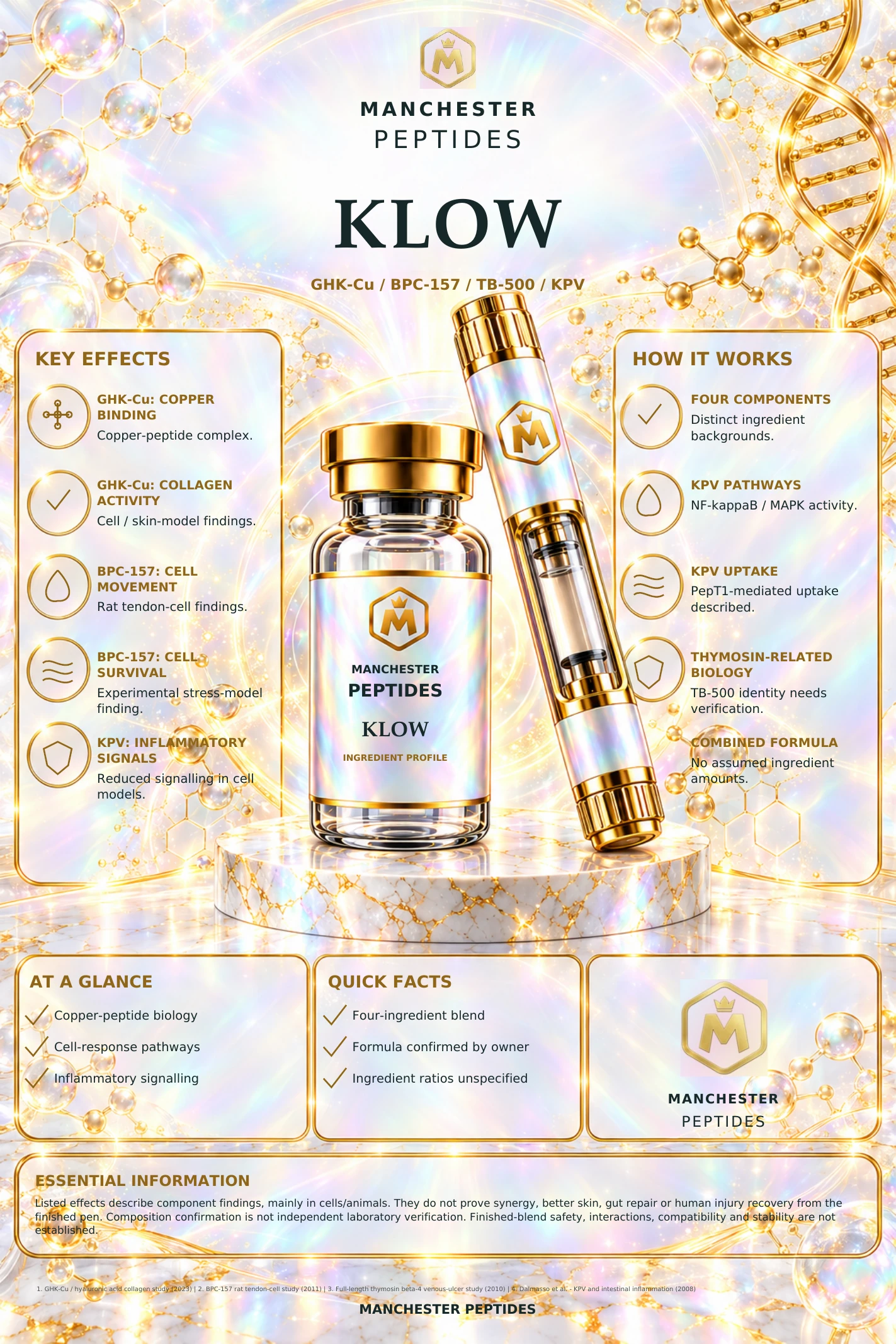
KLOW information poster
A visual guide to the GHK-Cu, BPC-157, TB-500 and KPV components associated with the KLOW blend name.
- Four-component blend
- Component research
- Combined-formulation evidence limits
This visual summary is a starting point. The linked research guide provides sources, evidence levels and limitations.
Detailed catalogue research
KLOW peptide blend ingredients and evidence
Read what GHK-Cu, BPC-157, TB-500 and KPV studies can establish about each ingredient and what remains unknown about their combination.
What is in the four-component KLOW peptide blend?
KLOW commonly refers to a mixture of GHK-Cu, BPC-157, TB-500 and KPV. Its commercial name is not a universal formulation specification. GHK-Cu includes copper coordinated to a tripeptide, KPV is another distinct tripeptide, and the BPC-157 and TB-500 names raise their own sequence and identity questions. A blend report should identify every component and the amount or activity claimed for that component.
What do KLOW component studies test?
A fibroblast study examined collagen synthesis with GHK-Cu. A rat tendon-cell study examined migration with BPC-157. A separate rat wound study used full-length thymosin beta-4, and KPV experiments looked at inflammatory signals in cells and mice. These outcomes cannot be added together. The studies did not use the same molecule, population or intervention, and they do not establish a benefit for the complete mixture.
How would KLOW combination research establish benefit?
A credible study would define the full formulation and test the combination against an appropriate control. To show synergy, it would also need a design that can distinguish the combined effect from the individual contributions. Even before a human trial, relevant analytical questions include whether each ingredient remains stable in the mixture and whether the test can distinguish each ingredient from impurities.
Sources for this research section
Questions answered
KLOW FAQs
What does KLOW actually do?
There is no established clinical answer for the complete blend. Its rationale comes from separate component studies in matrix, repair and inflammatory biology.
Is KLOW a sleep or anxiety peptide?
The component experiments linked here do not establish treatment of insomnia or anxiety. Those claims need direct human evidence for the exact formulation.
Does four ingredients mean four times the benefit?
No. Combining materials changes the scientific question; it does not multiply proven outcomes.
Check the sources
Sources and further reading
Follow the original study or official information to check the population, methods and full results. Reviews and sponsor updates are labelled below.
- Maquart et al.: GHK-Cu and collagen ↗Primary fibroblast-culture experiment, not an injectable clinical trial.
- Chang et al.: BPC-157 tendon-cell experiment ↗Primary rat tendon explant and cell study; not a human injury trial.
- Malinda et al.: thymosin beta-4 and wound repair ↗Primary rat wound and cell-migration study using thymosin beta-4.
- Dalmasso et al.: KPV and intestinal inflammation ↗Primary intestinal-cell and mouse-colitis experiments.
Educational information, prepared with AI assistance and not independently clinically reviewed. It is not personal medical advice or a treatment recommendation. Read the editorial policy or suggest a correction.