
Peptides explained
Melanotan II: how it works
Also known as: MT2 / MT-II
Page updated · Sources and editorial approach
Melanotan II acts on melanocortin pathways. Read about pigmentation research, early human findings, reported risks and UK public-health advice.
Melanotan II at a glance
What it does biologically
It mimics aspects of alpha-MSH signalling and can stimulate pigmentation. Melanocortin effects extend beyond skin colour.
What the evidence shows
A very small early human study observed pigmentation changes alongside nausea, fatigue and other effects.
What remains uncertain
An observed tanning effect does not establish long-term safety or protection from UV damage. UK public-health advice is not to use tanning injections or sprays.
The basics
What is Melanotan II?
Melanotan II is a synthetic cyclic peptide related to alpha-melanocyte-stimulating hormone, or alpha-MSH. It is distinct from afamelanotide and from bremelanotide; shared melanocortin biology does not make those medicines interchangeable.
The nickname MT2 does not identify an authorised tanning medicine. NHS inform advises against tanning injections and nasal sprays and explains that contents and long-term effects may be unknown.
Biological action
How does Melanotan II work?
Melanocortin signalling can affect pigment-producing cells. Melanotan II was designed to act on that signalling system, but it is not restricted to a cosmetic effect: early studies also observed nausea, sleepiness and spontaneous erections.
Skin darkening should not be interpreted as evidence of UV protection. Sun protection and assessment of a changing mole remain separate health questions.
Questions being investigated
What do studies examine?
Pigmentation
An early phase 1 pilot observed increased pigmentation in some participants.
Effects beyond pigmentation
The same pilot recorded effects involving nausea, fatigue and sexual responses.
Public-health advice
NHS inform advises people using these tanning products to stop and seek medical advice for adverse effects.
Strength of evidence
How strong is the evidence?
Evidence is separated by level because a cell experiment, an animal model, a human trial and a regulatory decision answer different questions.
| Evidence type | What it tells us |
|---|---|
| Laboratory | Melanocortin activity provides a biological explanation for pigmentation effects. |
| Animal | Preclinical activity does not establish the safety of a consumer tanning product. |
| Human | The 1996 pilot included only three men. It cannot establish broad or long-term safety. |
| Regulatory | UK public-health sources describe these tanning products as unauthorised and advise against use. |
Important context
Risks, limitations and unanswered questions
- A three-person pilot cannot detect uncommon or delayed harms.
- Unknown composition and injection-related risks are separate from receptor pharmacology.
- Nausea, vomiting, drowsiness and other adverse effects are reported in public-health guidance.
- No tanning effect removes the need for UV protection.
Reading the original evidence
A pilot phase 1 study cannot settle long-term safety
The cited publication is explicitly a pilot phase 1 study. Early observations are useful for further investigation, but they cannot answer every question about uncommon harms or long-term effects. An observed pigmentation change should not be presented as proof of protection against ultraviolet damage.
Question to take to the source: Are claims about tanning being kept separate from claims about skin protection and long-term safety?
Check the original source ↗For personal accounts and research questionnaires, read user feedback and patient-reported outcomes.
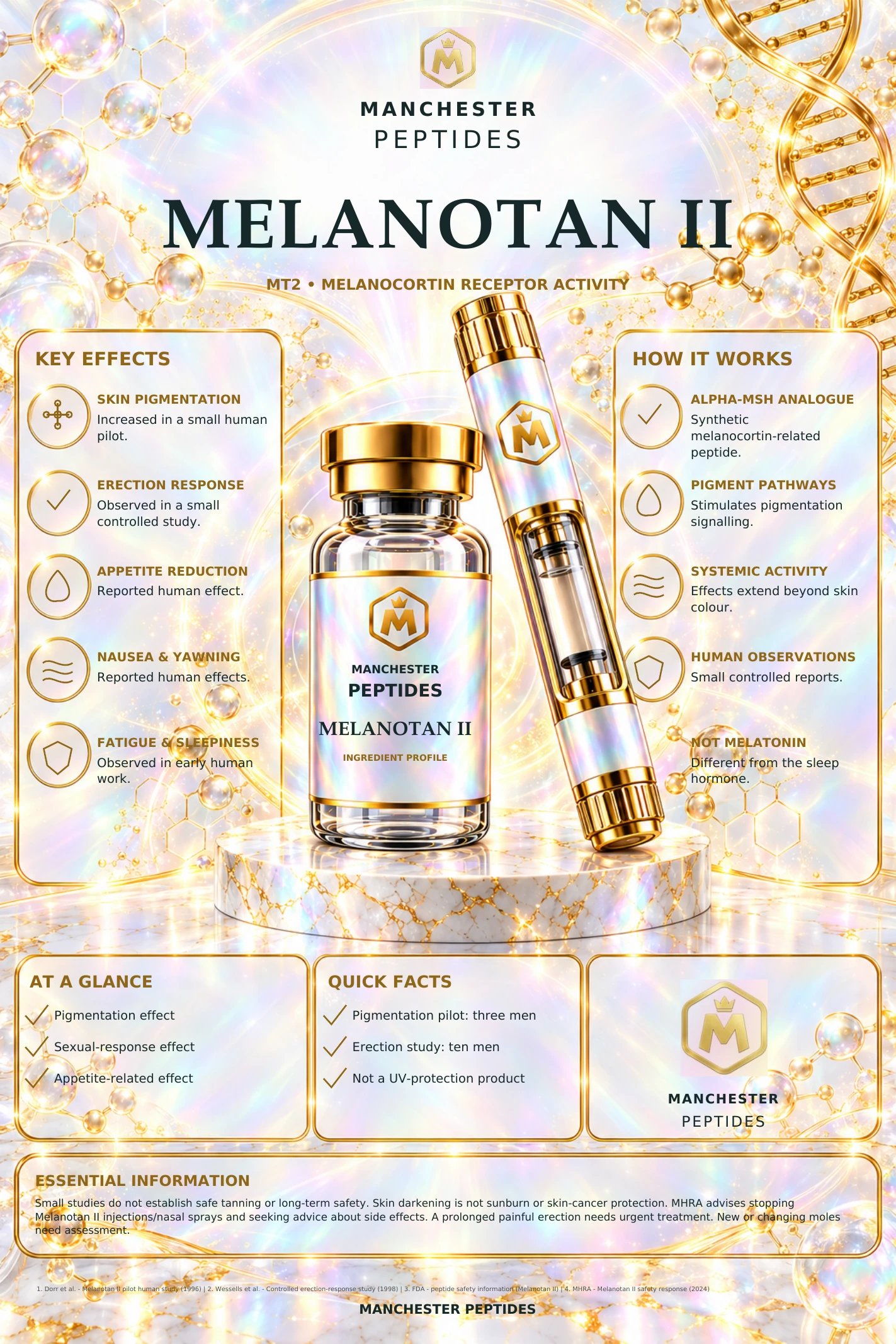
Melanotan IIView information poster+
Melanotan II information poster
A reference sheet about melanocortin receptor activity and pigmentation research. Read the linked guide for limitations and safety context.
- Melanocortin receptors
- Pigmentation research
- Research limitations
This visual summary is a starting point. The linked research guide provides sources, evidence levels and limitations.
Detailed catalogue research
Melanotan II (MT2): pigmentation research and safety
Read what the first Melanotan II study observed, how small it was and what NHS guidance says about tanning injections and nasal sprays.
What did early Melanotan II research find about skin pigmentation?
An early Phase 1 pilot studied three male volunteers and reported changes in pigmentation alongside other effects. That study size can show observations worth investigating. It cannot estimate how frequently side effects occur in the population or establish long-term safety. Read the number of participants before treating a result from early research as a reliable estimate.
Does an MT2-related tan protect skin from UV damage?
Skin colour and protection against harmful ultraviolet exposure are different outcomes. A darker appearance does not demonstrate less skin damage or reduced skin cancer risk. NHS inform advises against tanning injections and nasal sprays. Its guidance also explains why exposure to UV light and changes in moles remain separate health concerns.
How does Melanotan II differ from other melanocortin drugs?
The melanocortin system has multiple receptor subtypes and roles beyond pigmentation. Melanotan II, afamelanotide and bremelanotide are distinct substances. A study or regulatory decision about one cannot establish the safety of a different substance, a commercial MT2 formulation or another route. Compare the exact drug name in the source and the indication or outcome studied.
Sources for this research section
Questions answered
Melanotan II FAQs
Does MT2 affect pigmentation?
Pigmentation changes were observed in an early small human study, alongside other effects. That finding does not establish a safe tanning treatment.
Is Melanotan II the same as an authorised melanocortin medicine?
No. A related pathway or similar name does not make it the same medicine.
Does a tan mean protection from skin cancer?
No. Skin colour changes do not establish protection from UV damage or cancer.
Check the sources
Sources and further reading
Follow the original study or official information to check the population, methods and full results. Reviews and sponsor updates are labelled below.
- Dorr et al. (1996): pilot phase 1 study ↗Primary study in three male volunteers, with pigmentation and adverse observations.
- NHS inform: sunbed and tanning safety ↗UK public-health advice on tanning injections and sprays.
Educational information, prepared with AI assistance and not independently clinically reviewed. It is not personal medical advice or a treatment recommendation. Read the editorial policy or suggest a correction.