
Peptides explained
NAD+: how it works
Also known as: Nicotinamide adenine dinucleotide
Page updated · Sources and editorial approach
NAD+ is a cellular coenzyme involved in energy metabolism and enzyme signalling. Learn how its normal role differs from evidence for supplied NAD+ products.
NAD+ at a glance
What it does biologically
NAD+ accepts electrons during metabolism; its reduced form, NADH, helps transfer that energy through cellular reactions. NAD+ is also consumed by several signalling enzymes.
What the evidence shows
Its normal biochemical role is established. Human infusion studies are small and investigate metabolism or tolerability rather than proving rejuvenation.
What remains uncertain
Normal cellular importance does not establish that a particular supplied preparation improves energy, cognition or lifespan.
The basics
What is NAD+?
NAD+ is a coenzyme, not a peptide. Cells maintain it through synthesis and recycling pathways. NAD+ and NADH are two forms of the same redox system, involved in transferring electrons during metabolism.
NAD+ is different from the precursors nicotinamide riboside (NR) and nicotinamide mononucleotide (NMN). A study of one substance or delivery route cannot be treated as a study of all three.
Biological action
How does NAD+ work?
NAD+ participates in reactions that connect nutrient metabolism with cellular energy production. It is also used by enzymes involved in cellular responses, including sirtuins and PARPs. These are normal biological functions; they are not proof of an anti-ageing treatment.
When extra NAD+ is administered, its breakdown, distribution and recycling must be measured. A change in a blood metabolite does not show how much reaches a particular tissue or whether a person experiences a meaningful benefit.
Questions being investigated
What do studies examine?
Metabolic fate
A 2019 human pilot measured blood and urine metabolites during and after an infusion.
Tolerability
A 2026 retrospective comparison reported infusion symptoms and short-term laboratory markers, with important design limitations.
Ageing hypotheses
Mechanistic interest has not established that a supplied NAD+ preparation extends human lifespan.
Strength of evidence
How strong is the evidence?
Evidence is separated by level because a cell experiment, an animal model, a human trial and a regulatory decision answer different questions.
| Evidence type | What it tells us |
|---|---|
| Laboratory | NAD+ has well-established roles in redox reactions and enzyme biology. |
| Animal | Experimental ageing and metabolic findings depend on model and intervention; they do not establish a human product benefit. |
| Human | Small infusion studies address metabolism and tolerability. They do not establish broad wellness or longevity claims. |
| Regulatory | Being naturally present in cells does not confer medicinal authorisation on a supplied preparation. |
Important context
Risks, limitations and unanswered questions
- Infusion, oral precursors and other presentations are different interventions.
- The 2026 study was retrospective and commercially affiliated; it cannot establish causation.
- Symptoms including gastrointestinal discomfort, increased heart rate and chest pressure were reported during NAD+ infusions in that study.
- Changes in blood NAD+ do not establish anti-ageing or cognitive benefits.
Reading the original evidence
Metabolite measurements do not demonstrate rejuvenation
The 2019 pilot examined blood and urine metabolites during an intravenous NAD+ infusion. It addressed the handling of NAD+ and related substances in that setting. It was not a trial establishing longer life, reduced biological age or a general improvement in wellbeing.
Question to take to the source: Is a claim about a measured metabolite, or does it introduce a health outcome that the study did not assess?
Check the original source ↗For personal accounts and research questionnaires, read user feedback and patient-reported outcomes.
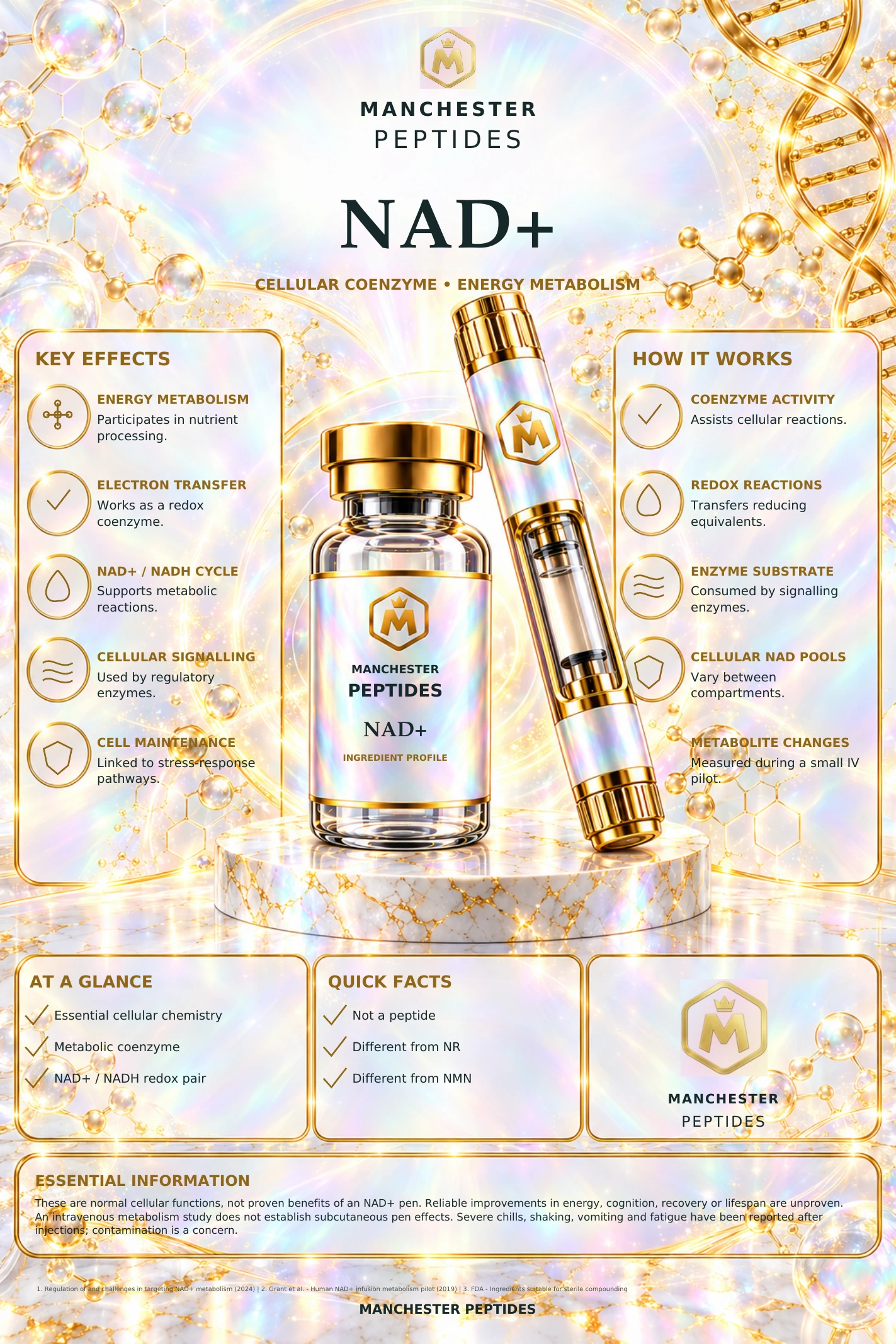
NAD+View information poster+
NAD+ information poster
A visual introduction to the NAD coenzyme, cellular energy transfer and redox biology.
- Cellular coenzyme
- Redox reactions
- Energy metabolism
This visual summary is a starting point. The linked research guide provides sources, evidence levels and limitations.
Detailed catalogue research
NAD+ infusion research, metabolism and NAD precursors
Distinguish NAD+ from NADH, NR and NMN and see what the human infusion pilot measured in blood and urine.
Is NAD+ a peptide, a coenzyme or an energy treatment?
NAD+ is nicotinamide adenine dinucleotide, a coenzyme used in normal cellular reactions. NADH is its reduced form. Both help describe how cells transfer electrons and handle energy. Having an essential role in metabolism does not establish that additional NAD+ will improve fatigue, exercise performance or wellbeing. Each claim needs evidence for the particular intervention and endpoint.
What did the 2019 human NAD+ infusion study measure?
The pilot measured NAD+ and related molecules in plasma and urine during and after an infusion. It was designed to describe the metabolic fate of the intervention. The samples provide information about those biological fluids at the measured times. They do not tell us whether a person had better cognition, more energy, or a sustained improvement in a health condition.
How are NAD+, nicotinamide riboside and NMN different?
NR and NMN are related precursors with their own processing pathways. A study of an oral precursor, a study of intravenous NAD+ and a study of ordinary intracellular NAD+ are different lines of evidence. When comparing them, read the formulation, route and measured outcome first. A change in a blood marker does not by itself establish a change in symptoms or long-term health.
Sources for this research section
Questions answered
NAD+ FAQs
Is NAD+ a peptide?
No. It is a coenzyme involved in cellular chemistry.
Does NAD+ give everyone more energy?
Its role in metabolism does not establish that adding it improves a person's energy or fatigue.
Are NAD+, NR and NMN interchangeable?
No. They are related through metabolism, but their uptake, processing and evidence differ.
Check the sources
Sources and further reading
Follow the original study or official information to check the population, methods and full results. Reviews and sponsor updates are labelled below.
- Grant et al. (2019): human NAD+ metabolome pilot ↗Small primary study of infusion-related metabolites; not an efficacy trial.
- Reyna et al. (2026): NAD+ and NR tolerability ↗Retrospective commercial-setting study with author employment conflicts disclosed.
Educational information, prepared with AI assistance and not independently clinically reviewed. It is not personal medical advice or a treatment recommendation. Read the editorial policy or suggest a correction.